

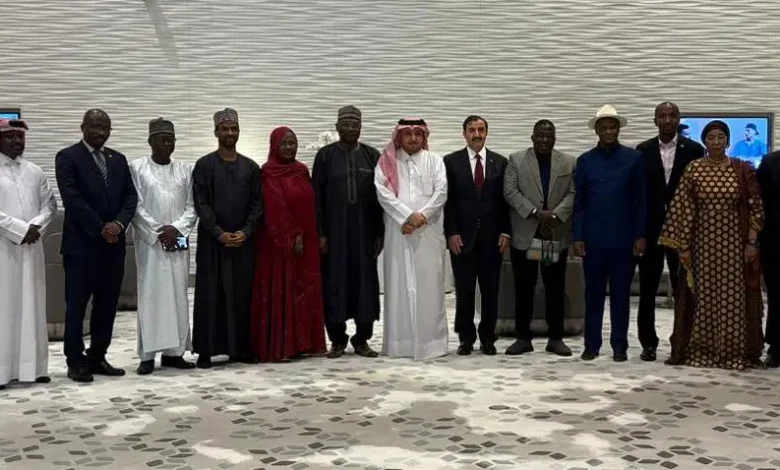
Professor Mahmood Yakubu, former Chairman of Nigeria’s Independent National Electoral Commission (INEC), has arrived in Doha, Qatar, where he is set to officially begin his responsibilities as Nigeria’s Ambassador. His appointment marks a significant career shift from managing one of the nation’s most sensitive electoral institutions to representing Nigeria in a key diplomatic position abroad.
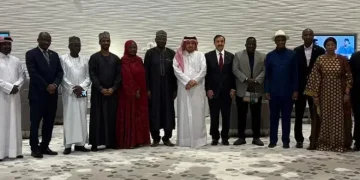
Upon his arrival at Hamad International Airport, Yakubu was formally welcomed by Ambassador Ibrahim Yousif Abdullah Fakhro, Director of the Protocol Department at the Qatari Ministry of Foreign Affairs. The reception was an indication of Qatar’s official acknowledgment of his diplomatic posting.
The arrival ceremony was attended by a notable gathering of 13 African ambassadors, along with the Secretary General of the Gas Exporting Countries Forum, Dr. Philip Mshelbila, and the President of the Nigerians in Diaspora Organisation in Qatar, Michael Ndukaihe Ihekwaba. Their presence highlighted the diplomatic weight attached to the appointment and the broader interest in Nigeria’s engagement with Qatar.
Yakubu’s deployment to Doha is widely viewed as a strategic foreign service assignment rather than a symbolic or retirement posting. Nigeria is expected to leverage his experience in governance and institutional leadership to strengthen bilateral relations with Qatar.
A major focus of his mission is anticipated to be the expansion of cooperation between both nations in the energy sector. As two major global producers of natural gas, Nigeria and Qatar share overlapping interests in global energy markets and international gas policy frameworks. His role is expected to support Nigeria’s long-term “Decade of Gas” initiative while tapping into Qatar’s established expertise and investment capacity.
He is also expected to work on strengthening collaboration in liquefied natural gas development, with efforts aimed at encouraging Qatari investment in Nigeria’s energy infrastructure. A key diplomatic challenge will be ensuring that both countries pursue complementary strategies that avoid unnecessary competition in global gas markets while promoting mutual benefit.
Beyond energy cooperation, Yakubu’s mandate is also expected to include advancing economic diplomacy aimed at attracting foreign direct investment into Nigeria. This aligns with ongoing domestic economic reforms, including changes to the foreign exchange system and the removal of fuel subsidies.
The Qatar Investment Authority, one of the world’s largest sovereign wealth funds with assets exceeding $500 billion, is viewed as a potential partner in Nigeria’s development drive. Areas of possible investment include agriculture, aviation, housing, transportation infrastructure, and digital technology.
Yakubu is also expected to play a role in strengthening ties with the Nigerian diaspora community in Qatar, ensuring better engagement and support for citizens living abroad while promoting Nigeria’s interests within the host country.
Overall, his diplomatic assignment is seen as part of Nigeria’s broader effort to deepen strategic partnerships with key global players, particularly in sectors that can support economic growth and long-term national development.