Ahead of the 2027 general elections, hopes of a united opposition front to challenge the ruling All Progressives Congress (APC) have suffered a major setback following the collapse of a coalition formed under the African Democratic Congress (ADC).
The alliance, which brought together several high-profile political figures to oppose President Bola Tinubu’s re-election bid, has been weakened by internal disputes, particularly over the party’s presidential ticket.
In March 2025, key political leaders including former Vice President Atiku Abubakar, former Senate President David Mark, former Kaduna State governor Nasir El-Rufai, former Minister of Transportation Rotimi Amaechi, and former Ekiti State governor Kayode Fayemi formed the coalition with the aim of unseating the APC in 2027. Other prominent figures such as Abdullahi Adamu, Rauf Aregbesola, and Abubakar Malami also joined the movement. In March 2026, former Kano State governor Rabiu Kwankwaso aligned with the coalition after leaving the NNPP. On July 3, 2025, the group formally adopted the ADC as its platform, with support from Peter Obi and other influential politicians.
However, the coalition soon became entangled in a leadership crisis. On July 2, 2025, the party’s founder, Ralph Nwosu, announced the resignation of the National Working Committee, paving the way for an interim leadership led by David Mark. This arrangement was challenged by a faction led by Nafiu Bala, a deputy national chairman, who insisted he never resigned and should automatically assume leadership in line with the party’s constitution.
Bala subsequently approached the Federal High Court in Abuja to stop Mark’s leadership from being recognized and to compel the Independent National Electoral Commission (INEC) to acknowledge him as acting national chairman. The legal dispute escalated through the courts. Although the Court of Appeal dismissed Mark’s challenge, the Supreme Court later restored him as national chairman on April 30, 2026. However, the apex court did not issue a final ruling on the underlying dispute, instead directing that the case return to the trial court for further hearing. INEC had earlier suspended recognition of Mark’s faction amid the uncertainty.
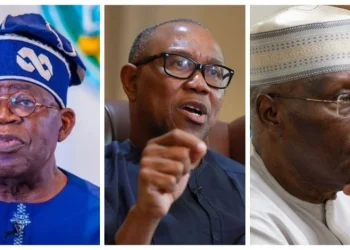
Beyond the leadership tussle, disagreements over zoning and the party’s presidential ticket further deepened divisions within the coalition. Atiku Abubakar and his supporters pushed for the ticket, while Peter Obi’s camp insisted it should remain in the South, arguing that Obi was better positioned. Tensions escalated as Obi’s supporters accused Atiku’s camp of attempting to influence party leaders financially, reinforcing earlier warnings from the Obidient Movement against participating in what they described as “dollarized” primaries.
The unresolved disputes triggered a wave of defections. Peter Obi and Rabiu Kwankwaso reportedly left the ADC to join the Nigerian Democratic Congress (NDC), alongside several lawmakers and party members. Former senator Ishaku Abbo also exited the party, citing the prolonged internal crisis, while some lawmakers from Kano State signaled plans to defect as well. Insiders indicate that more members may leave the party ahead of the INEC deadline.
Some party insiders believe the crisis ultimately benefits President Bola Tinubu, as a divided opposition could repeat the vote-splitting scenario that contributed to his victory in 2023. With key opposition figures now spread across different platforms, the prospects of a unified challenge in 2027 appear increasingly uncertain.