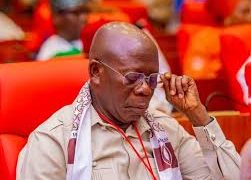


A former National Chairman of the All Progressives Congress (APC), Adams Oshiomhole, has publicly praised Minister of the Federal Capital Territory, Nyesom Wike, saying Wike stood by him at a time he felt abandoned by members of his own party.
Oshiomhole made the remarks in an interview on Monday, February 22, 2026, where he reflected on his political journey following his tenure as APC national chairman. He described a phase in his career when he felt marginalised within the party and said that Wike — despite being from a rival political grouping — offered him counsel and support during that period.
“I must say that Governor Wike stood by me when I believed the APC had abandoned me,” Oshiomhole said, noting that Wike’s gesture went beyond political rivalry and showed personal solidarity. He explained that while some of his political allies were distant at the time, Wike reached out, encouraged him and helped him stay engaged in public affairs.
The comments are notable given Wike’s own complex relationship with the APC. Wike, now Minister of the FCT, left the APC years ago and has been a vocal critic of the party’s internal leadership on several occasions. Despite ideological differences and party divides, Oshiomhole’s recognition of Wike’s support underscores a personal bond that transcended partisan lines.
Political observers say Oshiomhole’s praise highlights how personal relationships can cut across party boundaries in Nigeria’s political arena, especially at moments when leaders face challenges or internal conflict. They note that such acknowledgements are uncommon but reinforce the idea that political figures may find allies in unexpected quarters.
While speaking about his past experiences, Oshiomhole emphasised that leadership sometimes involves acknowledging those who helped along the way, even if they are not part of one’s immediate political circle. He described Wike’s gesture as meaningful and rooted in a sense of mutual respect, rather than mere political calculation.
Oshiomhole’s comments also come at a time when the APC is preparing for the 2027 general elections, and internal party cohesion remains a subject of public discussion. His statement signals that histories of personal support and political loyalty can shape narratives ahead of major electoral contests.
Supporters of Wike welcomed Oshiomhole’s remarks, saying they reflect a spirit of unity that is needed in national politics. They argued that moments of personal solidarity should be celebrated as examples of civility in Nigeria’s competitive political environment. Critics, however, pointed out that personal gestures of support should not overshadow broader policy differences and ideological stances that define party positions.
As Nigeria’s political landscape continues to evolve, Oshiomhole’s acknowledgment of Wike’s support — even at a time of perceived abandonment by his own party — adds a human element to the often highly strategic world of political alliances and rivalries.
Overall, the exchange illustrates how personal respect and recognition can endure beyond political divisions, and it sheds light on the complexities of leadership relationships within Nigeria’s multiparty system.