

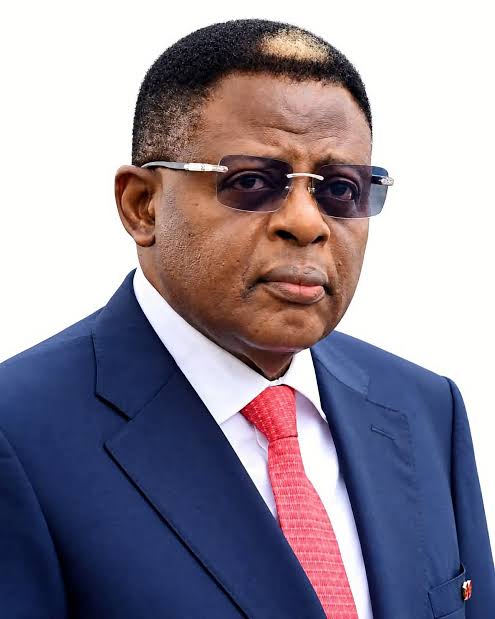
Cross River State Governor Bassey Otu says his administration has lowered the state’s domestic debt by more than ₦70 billion since taking office in 2023, adding that the reduction was achieved without obtaining new loans.
Otu made the disclosure on Saturday in Calabar while inaugurating the All Progressives Congress Campaign Council for the 2027 general elections.
He said his government came into office facing mounting financial obligations, security challenges and a workforce whose morale had suffered.
According to the governor, his administration initially prioritised stabilising the state’s finances, recovering public assets and creating conditions for economic growth rather than making sweeping promises.
Otu put the state’s domestic debt at over ₦204 billion in May 2023, when he assumed office, saying the figure had dropped by March 2026 following efforts to ease the financial burden.
He also reported an increase in internally generated revenue, which rose from ₦21.1 billion in 2022 to ₦46.3 billion in 2024, a development he linked to stronger revenue collection and fiscal management.
The governor said his administration’s recovery efforts had yielded gains, including the retrieval of Tinapa from the Asset Management Corporation of Nigeria and the recovery of nearly ₦1 billion from Etung Cocoa Estates.
He added that the government was pursuing the recovery of the state’s oil wells while protecting its interests in Bakassi and the proposed Deep Seaport project.
On public service reforms, Otu said his administration reopened recruitment, returned more than 3,000 local government employees to the payroll and began paying gratuities, with the first tranche released after nearly two decades.
He also highlighted ongoing development projects, including the reconstruction of the Obudu Cargo Airport runway, the revival of the Teachers Continuous Training Institute in Biase and the conversion of the College of Education, Akamkpa, into the University of Entrepreneurship.
Agriculture, he said, remained a key part of the government’s economic strategy, with investments targeting cocoa, rice, potatoes, oil palm and cassava production to strengthen food supplies and create jobs in rural communities.
In the technology sector, Otu disclosed that more than 200 kilometres of fibre infrastructure had been deployed in Calabar, while over 600 residents had received ICT training.
He further cited the state’s selection by the World Bank GovTech Team to participate in the 2026 AI in Governance and Public Administration Bootcamp in Seoul, South Korea, as an endorsement of its digital governance initiatives.
Outlining his priorities for a possible second term, the governor said the administration would focus on turning recovered assets into viable businesses, delivering major infrastructure projects and widening opportunities for young people and agricultural entrepreneurs.
He also pledged to pursue industrial parks across the state’s three senatorial districts and improve workers’ welfare.
Addressing campaign council members, Otu tasked them with taking the government’s record to communities across the state’s 18 local government areas and 196 wards.
He urged the council to build its campaign around verifiable achievements and the state’s future, arguing that continuity would allow ongoing projects and reforms to deliver results.
Otu subsequently inaugurated the council and called on its members to pursue an issue-based campaign focused on Cross River State’s development.