

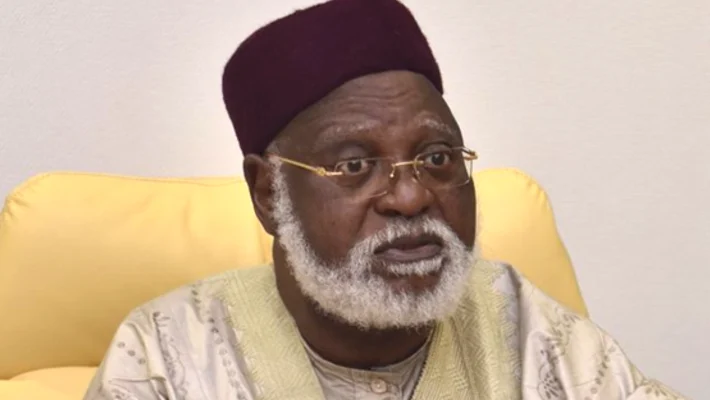
Leading figures in the (NADECO) National Democratic Coalition , retired Colonel Tony Nyiam and Chief Ayo Opadokun, have dismissed remarks made by former military Head of State, General Abdulsalami Abubakar, concerning both the transition to civilian rule in 1998 and the circumstances surrounding the death of Chief MKO Abiola.
The former pro-democracy leaders disputed Abdulsalami’s statement that members of NADECO privately encouraged his administration to prolong military governance after gaining confidence in his promise to transfer power in 1999.
They also questioned his position that Abiola’s death was not linked to foul play, arguing that his explanation did not sufficiently address long-standing concerns and public suspicions.
In his autobiography, Call of Duty, Abdulsalami wrote that several members of the coalition approached him shortly after he assumed office, proposing that military leadership remain in place for a longer period before handing over to elected civilian authorities. According to him, the request emerged within the early months of his administration.
The former ruler said he declined the suggestion and challenged those involved to publicly acknowledge making such a proposal.
Abdulsalami additionally maintained that allegations that Abiola was poisoned lacked factual support. He cited findings from a post-mortem examination reportedly conducted by medical specialists from Nigeria, the United States, Britain and Canada, which concluded that Abiola died from health complications connected to hypertension and heart-related conditions.
Responding to these claims, Nyiam described the account as inconsistent with the coalition’s historical objectives. He stated that throughout NADECO’s campaign, the central mission was to dismantle military governance and establish democratic rule rather than advocate for an extension of military authority.
According to Nyiam, Chief Anthony Enahoro, who led the movement abroad, consistently pushed for a transition based on due process and constitutional legitimacy. He explained that the coalition wanted a constitution developed through broad national consultation instead of the 1999 Constitution, which many critics viewed as originating from military arrangements.
Nyiam recalled meetings between representatives of Abdulsalami’s administration and exiled NADECO members in London. He said prominent figures participated in those discussions and unanimously requested a democratic framework built on national consensus rather than continued military administration.
He insisted that no recognised leader of the organisation advocated extending military control and suggested Abdulsalami may have misunderstood the conversations or interpreted them incorrectly.
Nyiam also challenged the former Head of State’s comments regarding Abiola’s death, saying available accounts over the years raised doubts about the official explanation. He argued that many supporters of the June 12 struggle remained unconvinced by the conclusion that natural causes alone explained Abiola’s passing.
He further urged Abdulsalami to identify individuals he believed abandoned or betrayed Abiola during the political crisis.
Similarly, Opadokun, who served as NADECO’s General Secretary, stated that the former military leader appeared to have misunderstood the position communicated by the coalition’s foreign-based members.
According to him, what NADECO sought was a carefully managed democratic transition supported by a people-driven constitution before elections took place.
Opadokun explained that the coalition’s proposal centred on establishing a government of national unity under MKO Abiola rather than maintaining military leadership.
He added that reports from NADECO members abroad suggested Abdulsalami may have misread the intention behind those engagements and discussions.