

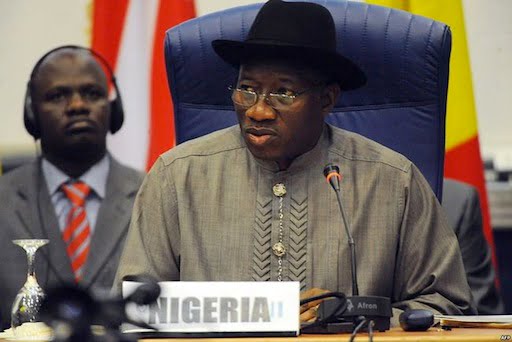
The Federal High Court sitting in Abuja on Tuesday postponed proceedings in a case aimed at preventing former Nigerian leader Goodluck Jonathan from taking part in the 2027 presidential election, fixing May 8 as the new date for substantive hearing.
The case was scheduled for mention before Justice Peter Lifu, who adjourned the matter after noting that the defendants had not yet submitted their responses. The court also instructed that all relevant hearing notices be properly issued and delivered to the parties involved before the next sitting. In addition, the judge emphasized that every required legal process must be completed ahead of the adjourned date to ensure smooth proceedings.
The legal action was filed by a practitioner, Johnmary Jideobi, who is requesting a permanent court order to stop Jonathan from contesting in the upcoming presidential poll. In the suit, identified as FHC/ABJ/CS/2102/2025, the claimant argues that the former president is not eligible under the law to seek election again.
Jideobi is also asking the court to bar the Independent National Electoral Commission (INEC) from accepting or including Jonathan’s name on the list of candidates for the 2027 election. Furthermore, the suit lists INEC and the Attorney-General of the Federation as defendants in the matter.
Relying on provisions of the 1999 Constitution, particularly Sections 1(1), (2), (3), and 137(3), the plaintiff is seeking judicial clarification on whether Jonathan still has the legal right to run for the presidency. According to his argument, Jonathan has already reached the maximum tenure allowed by law.
He contends that since Jonathan completed the remaining tenure of former President Umaru Musa Yar’Adua after his death and subsequently won and served a full term following the 2011 election, he has effectively occupied the office for the constitutionally permitted duration.
The claimant further informed the court that there are growing signs suggesting Jonathan may consider contesting in 2027. He warned that without early judicial intervention, a political party might nominate him, potentially leading to a constitutional violation.
He stated that if the judiciary does not act promptly, it could open the door for Jonathan to emerge as a candidate, which would raise serious legal concerns regarding eligibility.
In a supporting affidavit sworn by Emmanuel Agida, the plaintiff stressed that the case was initiated in the broader public interest, with the aim of preserving constitutional order and reinforcing the supremacy of the law.
The affidavit argues that allowing Jonathan to contest and possibly secure victory would mean he could be sworn into office for a third time, an outcome the plaintiff insists would breach the constitutional limit on presidential tenure.
It concludes by emphasizing that the legal challenge is intended to protect democratic principles, uphold the rule of law, and ensure that constitutional provisions are strictly followed.