

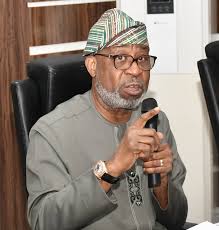
Nigeria’s Minister of Solid Minerals Development, Dr. Dele Alake, has credited President Bola Tinubu’s policy reforms with driving unprecedented growth in the country’s solid minerals sector, pointing to surging revenues, massive foreign investment, and growing global interest in Nigerian mining.
The minister attributed the gains — including the sector’s increased contribution to Nigeria’s Gross Domestic Product, higher foreign direct investment, and the country’s rising profile as a top mining destination — directly to President Tinubu’s reform agenda.
Revenue Surge
The sector generated over ₦38 billion in revenue in 2024, a remarkable jump from just ₦6 billion the previous year, even though it received only 18% of its ₦29 billion budgeted allocation. Alake described the turnaround as a testament to the effectiveness of the administration’s policy framework.
Foreign Investment and Lithium Projects
Driven by a new policy of local value addition and a tightened licensing regime, the sector attracted over $800 million in processing projects. Among the flagship investments, a $600 million lithium processing plant near the Kaduna-Niger border and a $200 million lithium refinery on the outskirts of Abuja are both nearing commissioning, alongside two additional processing plants in Nasarawa.
Alake noted that the former British Deputy Prime Minister personally invited him to Downing Street to discuss the UK’s interest in Nigerian lithium, and that the United States is also exploring Nigeria as an alternative to China for mineral sourcing.
Global Stage
Speaking through the Director-General of the Mining Cadastre Office, Obadiah Nkom, at the recently concluded Prospectors and Developers Association of Canada (PDAC) conference in Toronto, Alake emphasised Nigeria’s readiness to partner with credible investors committed to sustainable and responsible mining.
At the event, Alake called for deeper synergy among African nations, warning that integration on the continent fails not due to lack of frameworks, but because projects stall at borders — where a viable mine in one country may depend on a rail link, power line, or processing facility in another.
Crackdown on Illegal Mining
As part of its seven-point agenda, the ministry arrested over 300 illegal miners last year, with 150 prosecutions ongoing and nine convictions secured, including against foreign nationals. More than 250 mining cooperatives have also been established nationwide to absorb informal miners into the formal economy.
Looking Ahead
With ₦1 trillion now allocated for mineral exploration in the 2025 budget, the minister projected a record-breaking year, stressing that exploration was essential to attracting credible investors — noting that Nigeria had previously spent just $2 million on exploration, far below comparable African nations.
Alake concluded that Nigeria’s solid minerals sector has become a central pillar of the Tinubu administration’s broader economic diversification drive, with the government firmly committed to moving beyond raw mineral exports toward local processing and value creation.