

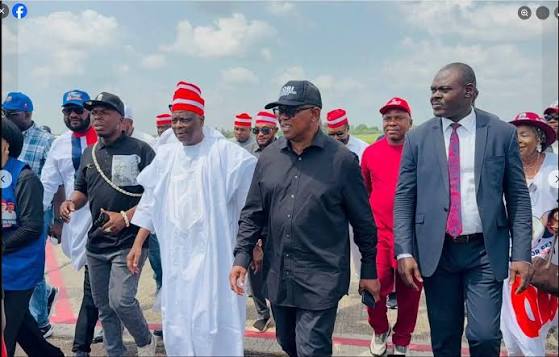
BENIN CITY, Edo State, November 25, 2026. Suspected political thugs allegedly opened fire on supporters of the Nigeria Democratic Congress (NDC) in Benin City on Wednesday, wounding at least one person. The reported attack came as the party’s presidential candidate, Peter Obi, and its leader, Rabiu Kwankwaso, arrived for a town hall meeting.
It is the second violent incident involving NDC candidates in two days. On Monday, a deadly attack hit a campaign event in Delta State for the party’s Delta Central senatorial candidate, Senator Ovie Omo-Agege.
Edo-born political commentator Albert Obazee first reported the incident. He said thugs attacked NDC supporters along Benin Airport Road as they waited for Obi and shot one person. New Telegraph reported that the attackers allegedly came with guns, cutlasses and other weapons.
In a statement by its National Publicity Secretary, Osa Director, the NDC said the attackers fired on supporters, assaulted people in the crowd and destroyed campaign vehicles and buses. It said several people were injured but did not name them. The party called the attack unprovoked and part of a wider pattern of violence against its members, candidates and structures. It demanded that the Edo Police Command and the Inspector-General of Police secure the area, investigate, and arrest and prosecute both the perpetrators and their sponsors.
Legit.ng reported that the NDC statement carried no details of a police response. Videos said to show the aftermath were circulating online but have not been independently verified. Leadership also reported gunshots as Obi and Kwankwaso arrived in Benin, though its page could not be opened for this report. No suspects or motive have been established.
On Monday, gunmen attacked Omo-Agege’s campaign team at Uduere in Ughelli North Local Government Area. Two of the dead were aides, Moses Anaughe and Akima Efemena Umukoro. Omo-Agege’s campaign initially reported four deaths and about 15 injuries. The police later said preliminary findings showed six people were killed.
The campaign alleged that the Ughelli North LGA Chairman, Jaro Egbo, led the attack on orders from Governor Sheriff Oborevwori. Egbo has in turn accused Omo-Agege and members of his entourage of involvement in the violence. None of these claims has been proven.
Omo-Agege spoke on Channels Television’s Sunrise Daily on Tuesday. He described the attack as the fifth attempt on his life, saying the assailants waited until he stood up to address supporters before opening fire and could be heard shouting that he was their target. He accused the police deployed to the venue of failing to act, saying they neither returned fire nor moved to protect his entourage. He added: “It was like they were there to supervise my execution.” He credited officers of the Department of State Services (DSS) attached to his security detail with saving his life. His campaign organisation separately alleged that officers who arrived at the scene with six trucks did nothing to stop the attack.
Police spokesperson CSP Ani Iniedu said Inspector-General of Police Olatunji Disu had ordered a comprehensive and impartial investigation, including a review of the actions of officers at the venue. The police said any officer found negligent would face disciplinary action or prosecution. The Delta government imposed a dusk-to-dawn curfew in Ughelli North. On Wednesday, police summoned Omo-Agege, the council chairman and five others, ordering Omo-Agege to report on Thursday, November 26. Aviation Minister Festus Keyamo, an APC figure, condemned the attack.
Analysis: a pattern, but not yet a proven one
- Timing and proximity. Both attacks hit NDC events within about 48 hours, in neighbouring states. The party now frames them as a trend, and the sequence gives that framing weight.
- The police question. Omo-Agege’s claim that officers were present but passive is the most serious allegation in the Delta case. It touches the credibility of the security response, and the police themselves have now ordered a review of their officers’ conduct. The outcome of that review is unknown, and the allegation remains unproven.
- Evidence gaps. The Delta case has named victims, a curfew and a police summons, though casualty figures have shifted. The Edo account so far rests on a commentator’s report, a party statement and online videos, with no police confirmation.
- Accountability is contested. In Delta, each side blames the other, and police have summoned the accuser and the accused alike. How the investigation proceeds will test perceptions of police impartiality. If no credible arrests follow in either state, the NDC’s call to hold authorities responsible will gain traction.
- Electoral stakes. Violence at campaign events can suppress turnout and raise the cost of campaigning for opposition candidates. Observers will be watching whether security is deployed evenly across all parties’ events.
The Edo Police Command had not issued a statement at the time of writing.