


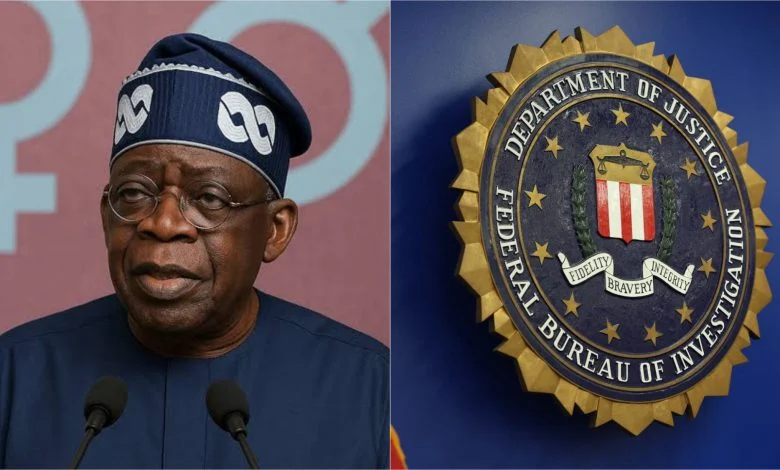
The United States District Court for the District of Columbia has been urged to take into account comments made by the Nigerian Presidency as it considers an ongoing Freedom of Information Act dispute involving records held by the FBI and the Drug Enforcement Administration concerning President Bola Ahmed Tinubu.
Von Batten-Montague-York, L.C. announced that its proposed amicus curiae submission had been received by the court clerk in the matter known as Greenspan v. Executive Office for U.S. Attorneys et al. The firm is seeking the court’s approval to participate as a “friend of the court” and present arguments relating to Tinubu’s privacy interests and the Nigerian government’s public discussion of records involved in the litigation.
The firm contends that statements made publicly by the Nigerian Presidency may be relevant to the court’s assessment of whether Tinubu’s privacy rights should continue to prevent disclosure of the documents.
According to the firm, the Presidency should not be able to publicly discuss the contents or significance of investigative records while simultaneously relying on privacy protections in a US federal court.
Its argument is that the government’s public comments could influence the balance between Tinubu’s claimed personal privacy and the public’s interest in understanding how US law-enforcement agencies handled the investigation and related records.
The development follows an earlier claim by the lobbying firm concerning an FBI filing in the same case. The firm said the filing referred to sensitive wiretap information contained within records sought through FOIA requests involving Tinubu.
Von Batten-Montague-York alleged that the FBI was seeking judicial protection for recordings gathered during an investigation involving individuals suspected of heroin trafficking. The firm further interpreted the filing as potentially indicating that Tinubu appeared on recordings associated with the investigation.
However, the organisation acknowledged that this interpretation was speculative and that the documents did not expressly establish the allegation. It also said its conclusion was based partly on its belief that Tinubu was the only individual it identified from the investigation who might still be alive.
The firm argued that the FBI had relied on FOIA Exemption 3 and federal laws governing the interception and disclosure of communications to justify withholding the material.
It has asked the court to reject the agency’s position and make the disputed recordings available, arguing that information concerning matters of significant public interest should not remain protected if the legal requirements for continued confidentiality are not satisfied.
The latest filing, however, does not itself determine whether the records will eventually be released. Rather, the firm says its immediate purpose is to ensure that the court considers the Nigerian Presidency’s public statements when assessing Tinubu’s privacy argument.
The underlying lawsuit began after Aaron Greenspan submitted FOIA requests in 2022 seeking US government documents connected to Tinubu. Following disputes over withheld records and agency responses, Greenspan brought the matter before a federal court in Washington, DC, in 2023. Tinubu was subsequently permitted to intervene.
The Presidency has repeatedly emphasised that the proceedings concern access to government documents and do not constitute a criminal prosecution of Tinubu.
Presidential spokesman Bayo Onanuga has stressed that the case involves the application of US freedom-of-information legislation rather than allegations of criminal wrongdoing.
The Nigerian government has also said that the FBI and DEA remain involved in the outstanding records dispute. It maintains that the agencies have released hundreds of pages, although portions have been withheld or redacted.
Tinubu has invoked FOIA Exemption 7(C), which can protect personal information contained in law-enforcement records.
The Presidency maintains that neither the disclosure nor non-disclosure of documents under FOIA should automatically be interpreted as proof of criminal conduct.