

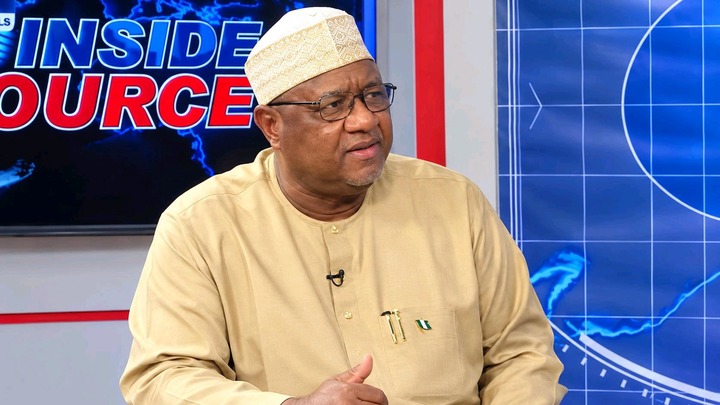
The Convener of the League of Northern Democrats, Umar Ardo, has alleged that former Kaduna State Governor Nasir El-Rufai was instrumental in stopping President Bola Ahmed Tinubu from becoming the running mate to former President Muhammadu Buhari during the 2011 presidential election.
Ardo made the allegation while speaking during an interview with Channels Television, where he discussed the political events and calculations that surrounded Buhari’s unsuccessful presidential bid under the Congress for Progressive Change (CPC).
According to Ardo, Tinubu was among the individuals who could have been considered for the vice-presidential slot on Buhari’s ticket at the time. However, he claimed that El-Rufai opposed the choice and instead advocated for Pastor Tunde Bakare to occupy the position.
Ardo alleged that El-Rufai actively supported Bakare’s candidacy and played a significant part in ensuring that he was eventually selected as Buhari’s running mate for the 2011 contest.
“It was El-Rufai who didn’t want Buhari to pick BAT as his vice president in 2011. He brought Tunde Bakare,” Ardo said during the television interview.
Bakare subsequently appeared on the CPC ticket alongside Buhari in the 2011 presidential election. Buhari contested against then-incumbent President Goodluck Jonathan and several other candidates in the election, but ultimately lost the contest.
The allegation has revived interest in the political negotiations and relationships that shaped Buhari’s campaign more than a decade ago. It also draws attention to the individuals who were involved in discussions over who would partner Buhari as his vice-presidential candidate.
At the time, Buhari was seeking the presidency under the CPC, a political platform that existed before the formation of the All Progressives Congress (APC). The eventual emergence of Bakare as his running mate became part of the political history surrounding Buhari’s fourth attempt to become Nigeria’s president.
Ardo’s comments have also gained significance because of the subsequent political relationship between Tinubu and Buhari.
Although Tinubu did not become Buhari’s running mate in 2011, the former Lagos State governor later became one of Buhari’s most important political allies. Their relationship became particularly prominent during the formation of the APC, which brought together several opposition political groups ahead of the 2015 general election.
Buhari eventually secured the presidency in 2015 on the APC platform, defeating Goodluck Jonathan. He went on to win another term in office in 2019.
Tinubu, meanwhile, remained a major figure within the APC and played a prominent role in the political activities of the party. His influence within the political structure continued to grow over the years, eventually culminating in his emergence as the APC’s presidential candidate for the 2023 election.
Tinubu went on to win the 2023 presidential election and succeeded Buhari as Nigeria’s president.
Ardo’s latest allegation therefore offers a retrospective view of the political decisions that surrounded Buhari’s 2011 campaign and the people who influenced his choice of running mate.
While Bakare ultimately occupied the position that year, Tinubu later established a political partnership with Buhari that would become central to the development of the APC and the eventual transfer of presidential power in 2023.
The comments have consequently renewed discussions about the political manoeuvring that took place before the 2011 election and how decisions made during that period shaped relationships among some of Nigeria’s most influential political actors.
Ardo’s account specifically places El-Rufai at the centre of the decision-making process concerning Buhari’s proposed running mate, alleging that the former Kaduna governor favoured Bakare over Tinubu.
The claim adds another layer to the political history of Buhari, Tinubu and El-Rufai, whose careers have remained closely connected to Nigeria’s opposition and governing politics over the past two decades.